
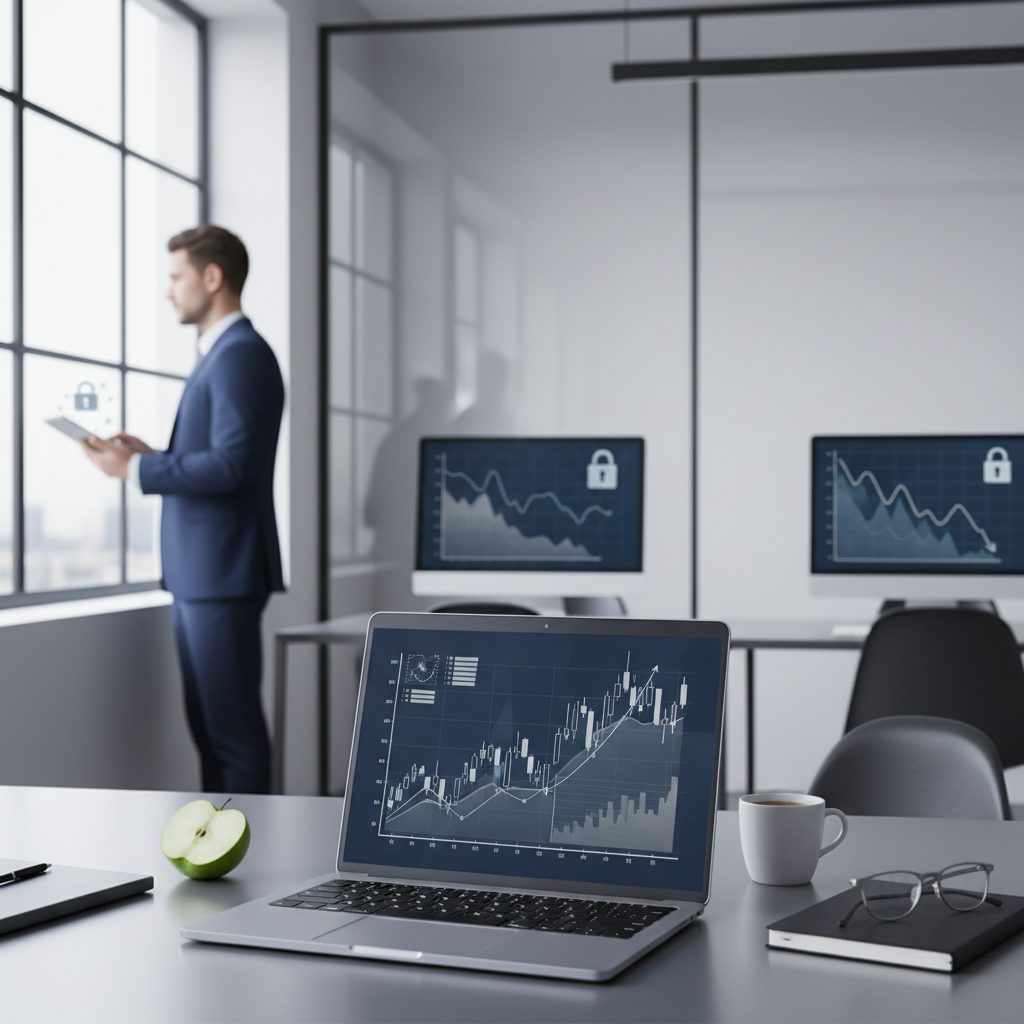
The Modern Surge of Day Trading in Corporate Environments
In offices around the world, an invisible productivity drain is quietly eroding team performance. An employee sits with multiple tabs open: a project management board on the primary display, and a minimized candlestick chart tracking Alphabet Inc. (GOOGL) on the secondary monitor. With mobile brokerage applications offering zero-commission trades and gamified interfaces, Google stock trading has migrated from a personal evening hobby into the active workday. What used to require a dedicated desktop terminal now takes place via a quick tap under a conference table or through a pinned browser tab.
Part of our complete guide: Phone Monitoring Software: The Complete Guide
Retail investing has experienced unprecedented growth over recent years. Driven by user-friendly fintech platforms, fractional share ownership, and push notifications, stock market engagement has democratized access to capital markets. However, the features that make modern investing accessible—vibrant user interfaces, real-time alerts, and instant execution—are the exact mechanisms that induce behavioral addiction. In an office setting, these continuous micro-engagements fracture an employee’s cognitive momentum.
The root of this distraction is neurochemical. Day trading activates the brain’s reward centers in a manner nearly identical to mobile gaming. Each market swing, earnings report preview, or pre-market gap triggers a burst of dopamine. When employees monitor high-profile equities during billable hours, their mental focus shifts from core organizational milestones to rapid price fluctuations. Meeting deadlines and writing thoughtful reports cannot compete with the immediate, visceral stimulation of a fluctuating financial portfolio.
Why Google Stock Trading Disrupts Office Productivity
Large-cap technology stocks like Google occupy a unique place in the market. As an anchor asset for institutional and retail investors alike, Alphabet experiences steady daily volume alongside intense volatility spikes during earnings season, regulatory reviews, and artificial intelligence product announcements. For an employee holding speculative equity options or day-trading shares, market fluctuations demand continuous vigilance. Unlike passive index funds, actively trading Google stock requires tracking order flow, technical resistance levels, and breaking technology news.
Social Trading Groups and Algorithmic Distractions
Day trading rarely happens in isolation. The modern retail investor operates inside a sprawling web of social channels. Discord servers, Reddit investment boards, Telegram groups, and financial influencers on X (formerly Twitter) generate a continuous stream of market sentiment. When an employee is actively engaged in Google stock trading, they are not simply glancing at a ticker every few hours; they are usually cross-referencing message boards, deciphering options chains, and evaluating commentary from anonymous market participants.
These platforms rely on aggressive push notifications to retain user engagement. Even if a worker resolves to focus on their assigned responsibilities, an automated alert about a sudden price drop or a volume surge immediately pulls them back to the market. The psychological urgency to avoid financial loss or capture short-term upside disrupts work focus, pulling staff out of collaborative tasks and into reactionary personal portfolio management.
The Severe Cognitive Cost of Context-Switching
The primary operational damage caused by workplace trading is not merely the cumulative minutes spent placing an order. The deeper issue is the cognitive penalty of context-switching. Research in cognitive psychology consistently demonstrates that human brains do not multi-task complex problems effectively; instead, they toggle between cognitive tracks. When an engineer, copywriter, or financial analyst interrupts deep analytical work to execute a trade or analyze a Google earnings release, their focus is broken.
Regaining deep focus after an interruption can take upwards of twenty minutes. During that transition window, error rates rise, analytical accuracy degrades, and overall output slows. An employee who checks their trading portal for two minutes twelve times a day has not merely lost twenty-four minutes of work. In practical terms, they have fragmented their entire eight-hour workday, leaving them unable to sustain deep analytical problem-solving.
The Hidden Costs of Unregulated Trading on Company Devices
When leadership teams overlook personal investing during work hours, they frequently underestimate the compounding organizational liabilities. Unregulated day trading touches multiple aspects of organizational risk, from direct payroll waste to infrastructure security and regulatory exposure.
- Direct Time Theft: An employee contracted for forty hours of focused operational work who devotes ten to fifteen hours weekly to personal market analysis is committing time theft. The business pays full compensation while absorbing delayed milestones, team friction, and missed client commitments.
- Network Degradation and Infrastructure Use: High-frequency market data feeds, continuous WebSocket connections to brokerages, and live streaming market commentary consume enterprise bandwidth, adding unnecessary load to corporate networks.
- Cybersecurity Vulnerabilities: To circumvent network firewalls or optimize trade speed, employees often install unauthorized desktop clients, browser extensions, or automated trading bots. These unvetted applications can bypass standard IT endpoint controls, exposing the enterprise network to malicious dependencies, data exfiltration, or remote execution vulnerabilities. Guidelines from the National Cybersecurity Alliance emphasize that unvetted software installations on company endpoints represent one of the most persistent attack surfaces for modern businesses.
- Regulatory and Compliance Exposures: If an employee uses company equipment or corporate network infrastructure to conduct trades, the company’s IP addresses become linked to those financial transactions. In regulated industries—such as legal counsel, accounting, government contracting, or public consulting—unauthorized trading can trigger severe conflicts of interest, violation of non-disclosure covenants, or scrutiny over potential material non-public information (insider trading).
- Trade Secret Vulnerabilities: When employees join external trading chat rooms, they may inadvertently share internal corporate context, product roadmaps, or vendor relationships to establish credibility within the investment community. This conversational leakage directly exposes organizations to corporate espionage and data compromise.
5 Strategic Methods to Prevent Trading Distractions at Work
Mitigating personal trading distractions requires a comprehensive approach. Purely punitive measures often drive the behavior onto personal smartphones, while total permissiveness invites declining operational standards. Organizations need an intentional framework that balances clear expectations, technical guardrails, and objective accountability.
1. Implement a Clear, Binding Acceptable Use Policy (AUP)
Ambiguity is the enemy of office productivity. If an employee handbook merely states that workers should “use company time responsibly,” employees will justify casual day trading as harmless downtime. An effective Acceptable Use Policy must explicitly classify personal stock, options, cryptocurrency, and commodity trading as an improper use of corporate time and hardware.
The policy should clearly define what is impermissible: running retail trading applications, maintaining active market feeds, and participating in market discussion forums during scheduled work shifts. Ensure every team member reviews and signs this document upon hiring, and conduct annual renewals to reinforce expectations. When boundaries are unambiguous, management can address productivity lapses transparently and objectively.
2. Restrict Trading Platforms via Network-Level Controls
Relying exclusively on self-discipline rarely works against gamified digital tools. Network administrators should implement domain and application filtering on corporate routers, firewalls, and managed DNS resolvers. By categorizing and blocking access to popular consumer brokerages, options trackers, and high-volume speculative forums, organizations remove casual temptation.
This technical boundary should also extend to browser extensions. Modern cloud-managed browsers allow IT teams to block extensions that display live ticker banners or pull stock prices into browser sidebars. For remote and hybrid personnel, these restrictions should be baked into company-issued virtual private networks (VPNs) and endpoint management profiles.
3. Deploy Responsible Employee Device Monitoring Solutions
Network filtering provides a strong baseline, but it stops short when workers transition to encrypted proxies, tethered connections, or company laptops operating outside the corporate network perimeter. Deploying professional oversight software, such as SPYERA computer monitoring software, gives business owners reliable visibility into which applications run on company-owned assets.
Responsible monitoring should always be conducted transparently. The objective is not covert surveillance of private lives, but protecting corporate resources and ensuring contractual duties are fulfilled on company-owned hardware. Modern monitoring solutions record active application windows, measure productive versus idle hours, and flag unauthorized software installations. When employees understand that device activity is periodically audited for compliance, non-work distractions decline substantially.
4. Educate Staff on Workplace Digital Wellness and Deep Work
Technical controls are most effective when supported by an organizational culture that values sustained attention. Many professionals fall into day trading out of boredom, task fatigue, or digital compulsion. Educating employees on cognitive load management, the value of deep work blocks, and digital wellness helps them recognize how context-switching harms their own career trajectories.
Encourage structured operational rhythms. Techniques like time-blocking—where workers dedicate uninterrupted ninety-minute intervals to strategic priorities without checking external tabs—help build professional focus. When an organization rewards project completion and creative problem-solving over frantic multi-tasking, teams naturally detach from digital distractions.
5. Establish Structured Review Checkpoints and Performance Metrics
Trading distractions flourish in environments characterized by vague goals and infrequent oversight. When progress is assessed only once a quarter, an employee can easily drift through weeks of reduced productivity without detection. Replacing vague objectives with weekly deliverables, clear milestones, and measurable Key Performance Indicators (KPIs) makes persistent distraction immediately apparent.
Managers should hold brief, regular one-on-one check-ins focused on tangible output. If an individual consistently misses project deadlines while exhibiting irregular active-window metrics on their computer, supervisors have concrete data to initiate performance remediation. Accountability removes the operational space required to sustain intensive intraday trading.
Operational Policy Comparison: Managing Workplace Focus
Choosing the right balance of interventions depends on company size, technical infrastructure, and team culture. The table below outlines how common interventions compare across implementation difficulty, daily effectiveness, and team trust.
- Acceptable Use Policy (AUP): Low implementation effort; moderate effectiveness on its own; highly supportive of workplace trust when introduced transparently.
- DNS & Firewall Blocking: Moderate implementation effort; high effectiveness against casual browsing; neutral impact on trust as a standard IT hygiene measure.
- Endpoint Device Monitoring: Moderate implementation effort; exceptionally high effectiveness against time theft and data leakage; requires clear written disclosure to maintain employee trust.
- Deep Work Training: High organizational effort; moderate long-term effectiveness; strongly positive impact on team culture and morale.
- Milestone-Based KPIs: Moderate management effort; high effectiveness; reinforces a healthy focus on results rather than mere presence.
Enforcing Workplace Focus with SPYERA Monitoring Solutions
Maintaining organizational efficiency requires objective insight into how enterprise resources are utilized. For over two decades, SPYERA has developed industry-grade monitoring technologies designed to help employers ensure company devices remain dedicated to legitimate business operations. Balancing corporate productivity with respectful oversight is an operational necessity, particularly across distributed, remote, and hybrid workforces.
Using SPYERA on company-owned computers and mobile endpoints allows administrators to observe exactly when and how enterprise hardware is engaged. If a worker spends three hours of an operational shift reviewing options chains, executing trades via desktop portals, or conversing in financial chat rooms, the platform captures detailed application logs, browser history, and active screen time records. This eliminates subjective arguments about output, providing leadership with verifiable data during performance and compliance reviews.
SPYERA helps defend companies against broader security liabilities. Personal trading frequently involves downloading third-party charting tools, custom indicators, and automated transaction scripts. These unapproved programs introduce severe vulnerabilities that can expose sensitive databases to external threats or facilitate corporate espionage. By tracking installed applications and system modifications, SPYERA empowers IT security teams to isolate unauthorized software before it compromises the internal network.
Ethical & Legal Framework: Monitoring software must always be deployed within legal, ethical, and transparent boundaries. Employers should ensure monitoring is restricted to company-owned hardware used for business duties, implement clear written acceptable use policies, and obtain explicit employee acknowledgment in compliance with all applicable regional and national employment regulations.
Implementation Checklist: Addressing Trading Distractions
If you suspect personal trading is reducing productivity within your team, follow this sequential roadmap to regain operational control:
- Audit Current Endpoint Software: Review software registries across company laptops to identify unvetted trading applications, standalone charting suites, and unauthorized browser add-ons.
- Update the Employee Handbook: Revise your Acceptable Use Policy to explicitly name equity, cryptocurrency, and options day trading as prohibited activities on company time and equipment.
- Configure Network Perimeter Filters: Update enterprise router rules, secure web gateways, and DNS firewalls to block high-traffic consumer brokerages and speculative investment forums.
- Deploy Transparent Monitoring Tools: Install centralized device monitoring across company-owned machines, ensuring staff receive formal written notification regarding oversight protocols.
- Align Management on Output Standards: Transition managers from tracking subjective active hours to tracking concrete, weekly milestones and objective deliverable timelines.
How SPYERA Can Help
SPYERA has helped parents and employers with Google stock trading since 1999. Monitor calls, messages, locations, and app activity on Android, iPhone, Windows, and Mac — used responsibly, with consent, on devices you own or are authorized to monitor.
Frequently Asked Questions
Is it illegal for employees to engage in Google stock trading during work hours?
Personal trading during work hours is generally not a statutory crime unless it involves non-public material information or regulatory non-compliance. However, it routinely violates corporate acceptable use policies and employment contracts, giving employers legitimate grounds for disciplinary action or termination.
Can employers legally monitor personal stock trading on company-owned computers?
In most jurisdictions, employers have the legal right to monitor internet traffic, keystrokes, and application usage on company-owned hardware. Transparency is essential; businesses should establish written acceptable use policies and obtain written employee acknowledgments before deploying monitoring software.
How can network administrators block trading platforms without disrupting necessary research?
IT departments can deploy category-based DNS filtering to block consumer brokerage domains and real-time execution platforms while permitting financial news hubs. When financial market access is necessary for a specific job role, administrators can establish role-based network exceptions.
What is the primary operational risk of unapproved trading software installed on corporate devices?
Beyond productivity loss, unauthorized trading platforms and third-party algorithmic extensions create significant cybersecurity vectors. These unvetted tools can leak proprietary network data, introduce malware, or expose internal assets to browser-based session hijacking.
How does SPYERA help businesses manage personal trading distractions?
SPYERA provides visibility into desktop and mobile software usage, alerting managers to unapproved financial applications, active browser windows, and excessive non-work screen time on company hardware. This oversight provides objective activity records while supporting compliance and productivity standards.